


Why have exchange-traded funds become such an important part of modern investing? For many people, the answer comes down to a combination of simplicity, diversification and relatively straightforward access to financial markets.
Instead of selecting dozens of individual shares, an investor can purchase a single ETF that tracks a broad market index or a specific investment theme. This structure has made ETFs particularly interesting for people who want to build wealth gradually rather than spend their time trading individual stocks.
However, popularity should not be confused with suitability. ETFs come in many different forms, and understanding what you are actually buying is essential before investing.
What Is an ETF?
ETF stands for Exchange-Traded Fund.
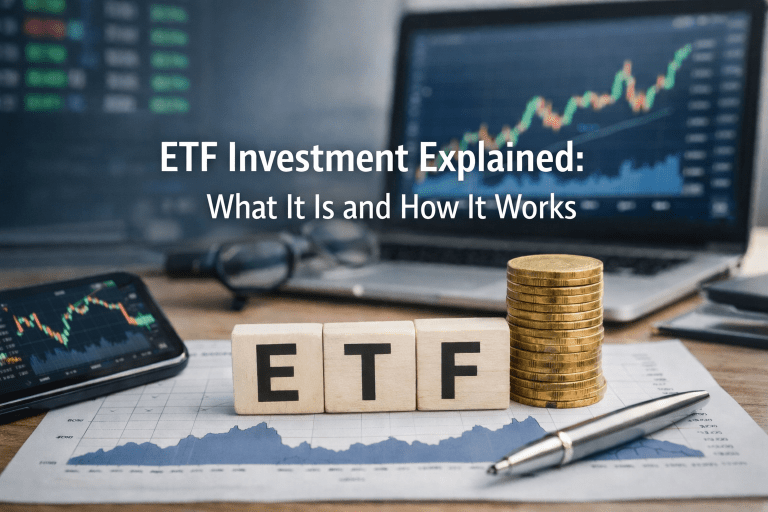
An ETF is an investment fund whose units are traded on a stock exchange. Depending on its structure, an ETF can hold shares, bonds, commodities or other securities.
One of the most common types is an index ETF.
An index ETF attempts to track the performance of a particular market index. Instead of trying to identify the companies that will outperform, the fund follows the composition of its chosen index.
This can give investors broad exposure through a single investment.
For example, a diversified equity ETF might contain hundreds or even thousands of companies from different countries and industries.
Why Is Diversification So Important?
Diversification is one of the main reasons ETFs attract long-term investors.
Imagine putting your entire investment into one company.
If that business suffers a major setback, your portfolio could experience a significant loss.
With a broad ETF, your investment may be spread across many companies.
One business performing poorly may have a relatively small impact on the overall portfolio.
Diversification can be achieved across:
- Companies
- Industries
- Countries
- Regions
- Currencies
- Asset classes
It does not eliminate risk, but it can reduce the consequences of relying heavily on one investment.
How Do Index ETFs Work?
An index is designed to represent a particular group of securities.
An ETF that tracks the index aims to replicate its performance as closely as possible.
The fund manager may hold the securities directly or use another method to achieve the desired exposure.
For an investor, the important point is that the objective is generally not to outperform the index through frequent stock selection.
Instead, the ETF seeks to follow its benchmark.
This approach is often described as passive investing.
Why Do Investors Like Passive Investing?
Traditional active funds typically involve managers who research securities and make decisions about what to buy and sell.
Passive funds take a different approach.
Rather than constantly trying to identify outperforming investments, an index ETF follows a predefined benchmark.
This can reduce the amount of active decision-making required.
For a long-term investor, that can be attractive.
Instead of asking which company will outperform next month, the investor can focus on broader questions such as:
- How much should I invest?
- Which market should I have exposure to?
- How long should I stay invested?
- How should my portfolio be diversified?
This can make the investment process more systematic.
Are ETFs Cheap?
ETFs can have relatively low ongoing costs compared with some actively managed investment products, but costs vary significantly.
One important measure is the Total Expense Ratio, often abbreviated as TER.
It represents certain ongoing costs associated with operating the fund.
However, investors should not look at TER alone.
Other factors can affect the actual cost of owning an ETF, including:
- Brokerage charges
- Bid-ask spreads
- Tracking difference
- Trading costs
- Currency-related costs
- Taxes
An ETF with a slightly higher TER can sometimes track its benchmark more effectively than another fund with a lower headline fee.
The overall cost and performance should therefore be considered together.
What Is a Sparplan?
A ETF-Sparplan allows an investor to contribute a fixed amount regularly.
For example, an investor might set up a monthly contribution of €100, €250 or €500.
The broker automatically invests the chosen amount according to the selected schedule.
This approach can be particularly useful for people who want to build an investment portfolio gradually.
Instead of waiting until they have a large amount available, they can invest smaller amounts regularly.
It also creates an investment routine.
The investor does not have to decide every month whether to make a purchase.
Does Regular Investing Remove Market Risk?
No.
This is an important distinction.
A Sparplan can make investing more systematic, but the value of the ETF can still fall.
If the underlying market declines, the investment will generally decline as well.
Regular contributions may mean that you purchase more ETF units when prices are lower and fewer when prices are higher, but this does not guarantee a profit.
Investors should be prepared for periods in which their portfolio is worth less than the amount they have contributed.
Why Do ETFs Suit Long-Term Investors?
Long-term investing requires patience.
Markets can experience substantial short-term volatility due to economic data, interest-rate decisions, political developments and company-specific events.
A diversified ETF can provide exposure to a broad collection of investments rather than concentrating the portfolio in one company.
This can make it easier for an investor to maintain a long-term strategy during periods of uncertainty.
However, the suitability of an ETF still depends on the underlying assets.
A narrowly focused technology ETF, for example, can be much more volatile than a broadly diversified global equity ETF.
The word “ETF” alone tells you very little about the actual risk.
What Should You Check Before Buying an ETF?
Never select an ETF simply because it has performed well recently.
Start by examining the fund’s investment objective.
Ask:
Which index does it track?
Which companies or securities does it hold?
How many holdings does it have?
Which countries are represented?
Which sectors dominate the portfolio?
How much does it cost?
Is the fund distributing or accumulating?
How large and established is the fund?
These questions can help you understand what you are actually buying.
What Is the Difference Between Accumulating and Distributing ETFs?
This distinction is important for investors.
A distributing ETF generally pays income generated by the underlying investments to the investor.
An accumulating ETF generally reinvests those income distributions within the fund.
Neither structure is automatically better.
The appropriate choice depends on your investment objectives, cash-flow requirements and tax situation.
German investors should also understand how investment income and relevant tax rules apply to ETFs before making a decision.
Are Global ETFs Really Global?
Not necessarily.
The word “global” in an ETF’s name does not automatically mean that every country has equal representation.
Many broad global indices have significant exposure to large developed markets and can have substantial weighting toward particular countries or companies.
For example, a global equity portfolio may still have a large allocation to US companies because of the size of the US stock market.
This is not necessarily a problem.
It simply means investors should look at the actual index composition instead of relying solely on the fund’s name.
What About Currency Risk?
International ETFs can expose investors to several currencies.
Suppose an ETF holds companies whose shares are denominated in US dollars.
Even if those companies perform well, changes in the euro-dollar exchange rate can influence the return experienced by a euro-based investor.
Currency movements can therefore affect investment results.
Some ETFs offer currency-hedged versions, but hedging also involves costs and does not automatically produce better returns.
Whether currency hedging is appropriate depends on the investor’s objectives and risk considerations.
Can ETFs Fall Sharply?
Absolutely.
An ETF is not a savings account.
A broad equity ETF can decline substantially during a major market downturn.
For example, global stock markets can fall because of:
- Recession fears
- Financial crises
- Geopolitical events
- Interest-rate increases
- Weak corporate earnings
- Investor panic
The fact that an ETF contains hundreds of companies does not prevent the overall market from declining.
Diversification reduces company-specific risk, but it does not eliminate market risk.
Should Beginners Choose One ETF or Several?
There is no universal answer.
One broadly diversified ETF can potentially provide exposure to a large number of companies.
Adding more ETFs can increase diversification, but it can also create unnecessary complexity.
Two funds may appear different while holding many of the same companies.
This can result in overlapping exposure rather than meaningful diversification.
Before adding another ETF, check whether it actually contributes something different to your portfolio.
How Long Should You Hold an ETF?
The appropriate holding period depends on the investment objective.
Equity ETFs are generally more suitable for investors who can tolerate significant fluctuations and remain invested for a longer period.
If you know you will need the money within a few months, putting it into a volatile equity ETF may expose you to unnecessary timing risk.
The closer you are to needing the money, the more important capital stability may become.
Investment selection should therefore begin with the question:
When will I need this money?
Why Should You Avoid Chasing Past Performance?
An ETF that delivered excellent returns over the previous year may attract a lot of attention.
But past performance does not guarantee future results.
A particular sector may have experienced exceptional growth because of temporary economic conditions, changing valuations or investor enthusiasm.
Buying after a major rise can expose investors to the risk of entering at an expensive valuation.
Instead of asking only which ETF performed best recently, examine whether the underlying investment fits your long-term strategy.
How Do Taxes Fit Into ETF Investing?
Investment income and capital gains can have tax implications.
German investors should understand concepts such as the Freistellungsauftrag, Sparer-Pauschbetrag and the taxation applicable to investment funds.
The specific treatment can depend on the investor’s circumstances and the type of investment.
This is one reason it is useful to understand the tax characteristics of an ETF before building a substantial portfolio.
Final Thoughts
ETFs have become popular because they can combine broad diversification, relatively straightforward access and systematic investing in a single product.
For long-term investors, an ETF can reduce the need to select individual companies and constantly monitor market prices. A regular ETF-Sparplan can also make it easier to invest consistently over time.
But ETFs are not risk-free.
Before investing, examine the underlying index, holdings, costs, geographical exposure, sector concentration, distribution method and potential currency effects.
Most importantly, choose an ETF based on your financial objectives rather than recent performance or online popularity.
The real advantage of ETFs is not that they make investing effortless or guarantee attractive returns. Their value lies in providing a structured way to gain market exposure while maintaining a diversified, long-term investment approach.