



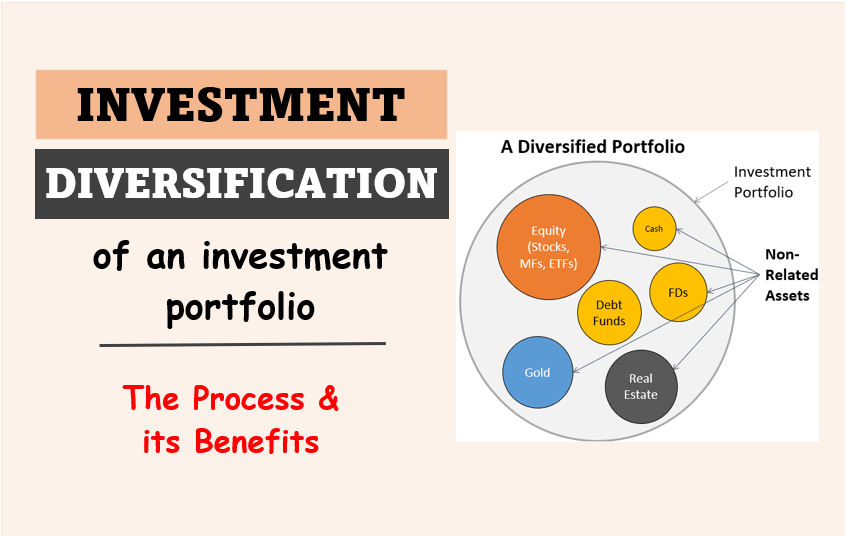
Can you really make investing safer simply by owning more than one asset? Diversification is one of the most widely discussed principles in investing, yet it is often misunderstood. Some investors believe that owning many stocks guarantees protection from losses, while others think diversification means buying as many different investments as possible.
Neither explanation is accurate.
A properly diversified portfolio can reduce certain types of investment risk, particularly the risk associated with depending too heavily on one company, sector or market. It cannot eliminate losses, and it cannot protect investors from every economic event.
Understanding what diversification can—and cannot—do is essential when building a long-term portfolio.
What Does Diversification Actually Mean?
Diversification means spreading your investment exposure across different assets rather than concentrating your money in one place.
The idea is straightforward.
If your entire portfolio depends on one company and that company fails, your financial loss could be severe.
If the same amount of money is spread across hundreds of companies, the failure of one business should have a much smaller effect on the overall portfolio.
Diversification can take several forms.
You can diversify across:
- Companies
- Industries
- Countries
- Regions
- Currencies
- Asset classes
- Investment strategies
The objective is to avoid having your financial future depend too heavily on one specific outcome.
Why Is Concentration Risk Dangerous?
Imagine an investor puts €20,000 into one company.
The company experiences a major financial problem and its share price falls by 60%.
The investor’s portfolio has now lost €12,000.
There is no guarantee that the company will recover.
Now consider an investor with €20,000 spread across hundreds of companies through a diversified ETF.
If one company falls by 60%, its impact on the overall portfolio may be relatively small.
This does not mean the diversified portfolio cannot decline.
It means the investor has reduced company-specific risk.
What Is Company-Specific Risk?
Company-specific risk refers to risks that primarily affect one business or a small group of businesses.
Examples include:
- Management problems
- Accounting scandals
- Product failures
- Cyberattacks
- Lawsuits
- Loss of major customers
- Competitive disruption
- Regulatory problems
- Excessive debt
These events can cause significant losses for individual shareholders.
Diversification helps because the performance of the entire portfolio does not depend on one company’s success.
Can You Diversify With ETFs?
Yes.
One of the reasons broad-market ETFs are popular is that they can provide exposure to many companies through a single investment.
For example, a broad equity ETF might contain companies from different industries and countries.
Instead of purchasing individual shares one by one, the investor gains exposure to a large group of securities through the fund.
However, investors should examine what the ETF actually holds.
Not every ETF is broadly diversified.
A fund focused exclusively on one industry may contain many companies but still be highly concentrated in one economic area.
How Many Investments Are Enough?
There is no magic number.
Owning ten stocks is not necessarily diversified if all ten belong to the same industry.
Owning 100 stocks may still leave you heavily exposed to one country.
The quality of diversification matters more than simply counting the number of holdings.
A portfolio containing companies from several sectors and regions may be more diversified than one containing hundreds of companies from a single industry.
This is why investors should examine correlations and exposure, not just the number of securities.
What Is Correlation?
Correlation describes how investments tend to move in relation to each other.
If two investments almost always rise and fall together, owning both may provide less diversification than expected.
For example, holding several technology companies may look diversified because they are different businesses.
But if they are all affected by the same technology-sector trends, their prices may decline simultaneously.
Investments that respond differently to economic conditions can provide greater diversification.
This is one reason investors sometimes combine different asset classes.
Can Different Countries Improve Diversification?
Geographical diversification can reduce dependence on one economy.
A portfolio focused entirely on one country is exposed to that country’s:
- Economic growth
- Political environment
- Currency
- Regulation
- Interest rates
- Consumer demand
Adding international investments can spread some of these risks.
However, global markets are increasingly connected.
A major financial crisis can affect markets across many countries simultaneously.
International diversification can therefore reduce concentration but cannot eliminate global market risk.
What About Different Industries?
Sector diversification is another important consideration.
Different industries respond differently to economic conditions.
For example:
Financial companies can be sensitive to interest rates and credit conditions.
Consumer businesses may depend heavily on household spending.
Industrial companies can be affected by economic growth and investment cycles.
Technology companies may be influenced by innovation, competition and valuation expectations.
Energy companies can be particularly sensitive to commodity prices.
Holding multiple sectors can reduce dependence on the performance of one particular part of the economy.
Does Diversification Protect Against a Market Crash?
Not completely.
During a major market downturn, many assets can decline simultaneously.
If global equity markets fall sharply, a portfolio consisting entirely of stocks can experience significant losses even if it contains thousands of companies.
This is known as market risk or systematic risk.
Diversification is much more effective against company-specific risk than against broad market declines.
Investors should understand this before assuming that a diversified portfolio cannot lose substantial value.
Can Bonds Improve Portfolio Diversification?
Depending on the investor’s circumstances, bonds can provide a different source of exposure from equities.
Government and corporate bonds behave differently from shares because their returns depend on interest payments, credit risk and changes in market yields.
However, bonds are not risk-free.
Their market value can decline when interest rates rise, and corporate bonds carry credit risk.
The role of bonds in a portfolio therefore depends on factors such as:
- Investment horizon
- Risk tolerance
- Income requirements
- Interest-rate environment
- Financial objectives
Why Is Cash Also Relevant?
Cash and cash-like assets can provide liquidity.
Unlike shares, cash does not normally experience the same day-to-day market fluctuations.
However, inflation can reduce its purchasing power over time.
Holding too much cash can therefore create a different type of risk.
The purpose of diversification is not to eliminate every form of risk. It is to create a balance that fits the investor’s circumstances.
How Does Diversification Affect Returns?
Diversification can reduce the impact of both winners and losers.
Suppose you own one company that increases by 100%.
Your portfolio benefits substantially.
But if another company falls by 80%, the diversified portfolio absorbs part of that loss.
This means diversification may reduce the chance of achieving an extraordinary return from a single successful investment.
At the same time, it reduces dependence on a single investment being successful.
For many long-term investors, this trade-off is worthwhile.
The objective is often to achieve a more balanced risk-return profile rather than trying to identify one exceptional investment.
What Is Over-Diversification?
More diversification is not always better.
An investor can own so many funds and securities that the portfolio becomes difficult to understand and manage.
For example, someone might hold:
- A global ETF
- A European ETF
- A US ETF
- A technology ETF
- Several individual technology stocks
- A dividend ETF
- A large-company ETF
At first glance, this appears highly diversified.
But many of these investments may hold the same companies.
The investor may therefore have more overlap than expected.
This is sometimes referred to as over-diversification.
How Can You Check for Overlap?
Look at the holdings of your ETFs and funds.
Identify the largest positions.
If the same companies appear repeatedly, your actual exposure may be more concentrated than you realize.
Also examine sector and geographical weightings.
A portfolio may contain ten different funds while still having a large combined allocation to a small number of companies.
Understanding the underlying exposure is more important than simply counting the number of products.
Why Should Your Investment Horizon Influence Diversification?
Your investment horizon can affect how much volatility you can reasonably tolerate.
Someone investing for retirement several decades away may have more time to recover from market declines.
Someone saving for a property purchase in two years may have much less flexibility.
The same diversified portfolio can therefore be appropriate for one investor and inappropriate for another.
Before selecting investments, consider when you expect to need the money.
How Should Beginners Build a Diversified Portfolio?
Simplicity can be useful.
Instead of immediately purchasing numerous funds, a beginner can start by understanding the main categories of exposure.
For example:
Equities: Potential long-term growth but significant volatility.
Bonds: Different risk and return characteristics, depending on the type.
Cash: High liquidity but potentially lower long-term purchasing-power growth.
The appropriate combination depends on the individual’s circumstances.
A broad ETF can sometimes provide substantial equity diversification without requiring dozens of separate investments.
Can Diversification Guarantee a Profit?
No.
This is perhaps the most important point.
Diversification is a risk-management technique, not a profit guarantee.
A diversified portfolio can still lose money.
During a major market downturn, the decline can be substantial.
The benefit is that the portfolio is less dependent on the success of any single company, sector or region.
Final Thoughts
Diversification is one of the fundamental principles of long-term investing because it can reduce the consequences of concentration in individual companies or markets.
A diversified portfolio can spread exposure across companies, industries, countries and potentially different asset classes. Broad ETFs can make this process relatively straightforward for many investors.
But diversification has limits.
It cannot eliminate market-wide declines, guarantee positive returns or protect every investment from falling at the same time.
The goal is therefore not to own as many investments as possible. It is to build a portfolio where no single company, sector or economic outcome has more influence than you are comfortable accepting.
For long-term investors, effective diversification is ultimately about balancing opportunity and risk. A well-structured portfolio may not produce the biggest possible gain in every market, but it can reduce unnecessary concentration and provide a more resilient foundation for pursuing long-term financial goals.