


Looking at a mortgage advertisement, it is easy to focus on one number: the monthly payment. A figure that appears affordable can make a property seem financially manageable. But a mortgage payment is only one part of the real cost of owning a home.
For anyone planning a Baufinanzierung, understanding how the monthly payment is calculated is essential. The interest rate, initial repayment rate, loan amount, fixed-interest period and additional ownership costs all influence whether a mortgage fits comfortably into a household budget.
A well-planned mortgage should not simply be affordable today. It should remain manageable when household expenses, maintenance costs and other financial commitments change.
How Is a Mortgage Payment Calculated?
A typical German mortgage payment consists primarily of two components:
- Zinsen – interest charged by the lender
- Tilgung – repayment of the borrowed principal
For example, suppose you borrow €300,000 with an initial interest rate of 4% and an initial repayment rate of 2%.
The initial annual payment would be approximately 6% of the original loan amount:
€300,000 × 6% = €18,000 per year
That corresponds to roughly:
€1,500 per month
This is a simplified illustration. Actual mortgage calculations depend on the specific loan agreement and repayment structure.
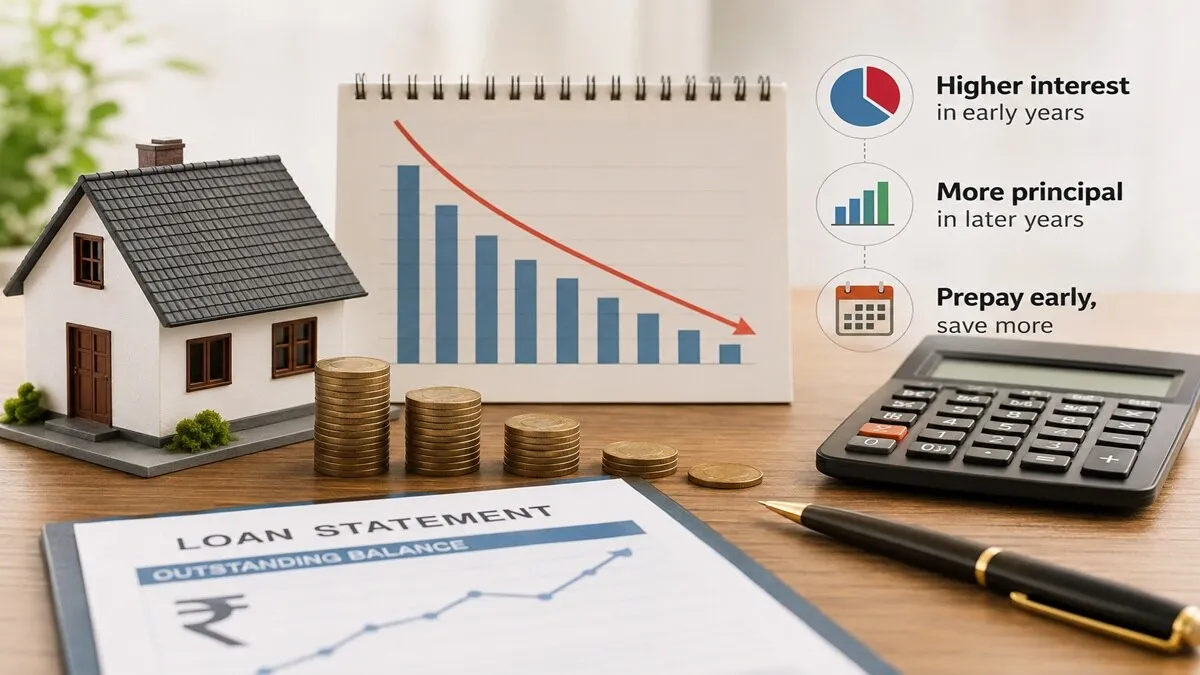
As the outstanding mortgage balance decreases, the interest component gradually falls. More of the payment can then go toward reducing the remaining principal.
Why the Initial Repayment Rate Matters
The Tilgungssatz determines how quickly you initially repay the mortgage.
A lower repayment rate generally produces a lower monthly payment, but the outstanding loan balance decreases more slowly.
A higher repayment rate increases the monthly payment but allows you to reduce your debt faster.
Consider a €300,000 mortgage:
2% initial repayment:
Interest + repayment may initially equal around 6% annually when the interest rate is 4%.
3% initial repayment:
The initial annual payment could be around 7%.
The second option requires more money every month, but the outstanding balance is reduced more quickly.
Choosing the right repayment rate therefore involves balancing current affordability with long-term debt reduction.
What Happens to the Interest Portion Over Time?
German mortgages are generally structured so that the interest is calculated on the remaining loan balance.
At the beginning of the mortgage, the outstanding balance is at its highest level. Consequently, the interest portion of the payment is also relatively high.
As you repay the principal, the outstanding balance falls.
This means the interest calculation is applied to a progressively smaller amount.
For borrowers who want to reduce the total cost of financing, accelerating repayment can therefore be beneficial.
However, increasing the repayment rate should only be done if the resulting monthly payment remains comfortable.
Why You Shouldn’t Use Your Maximum Borrowing Capacity
A bank may determine that you are capable of handling a particular mortgage payment. That does not necessarily mean you should borrow the maximum amount available.
Your household budget may also need to cover:
- Utilities
- Heating
- Insurance
- Food
- Transportation
- Childcare
- Maintenance
- Property-related taxes
- Savings
- Unexpected expenses
Homeowners should also expect periodic expenses that do not occur every month.
A roof repair, heating-system replacement or major renovation can cost thousands of euros.
For this reason, a sensible mortgage budget should leave room for unexpected expenses.
How Much of Your Income Should Go Toward Housing?
There is no universal percentage that works for every household.
A single person with no dependents may have a completely different financial situation from a family with children and several other monthly commitments.
Instead of relying on one fixed percentage, calculate your actual disposable income.
Start with your net household income and subtract regular expenses.
Then consider the mortgage payment alongside property-related costs.
This gives you a much more realistic idea of what you can afford.
Don’t Forget the Costs of Owning the Property
A mortgage calculator can show your estimated loan payment, but it does not automatically represent the complete monthly cost of homeownership.
You may also need to budget for:
Maintenance
Property owners are responsible for maintaining their homes. Older buildings can require particularly significant repairs.
Insurance
Depending on the property, various insurance policies may be appropriate.
Utilities
Heating, electricity and water can represent a significant portion of monthly household spending.
Property-Related Charges
Owners may also face local property taxes and other recurring costs.
Reserve for Repairs
Building a maintenance reserve can prevent a large unexpected expense from becoming a financial crisis.
How Does the Interest Rate Affect the Payment?
The interest rate has a direct effect on the cost of financing.
Suppose you borrow €350,000.
At a 3.5% interest rate, the initial interest cost is considerably lower than at 4.5%, assuming the same outstanding balance.
That difference may look small when expressed as a percentage, but it can represent several thousand euros over a longer period.
This is why comparing Baufinanzierung offers is so important.
However, borrowers should compare the complete conditions rather than choosing an offer solely because it has the lowest advertised interest rate.
What Is the Zinsbindung?
The Zinsbindung is the period during which the agreed mortgage interest rate remains fixed.
Common fixed-rate periods include 10, 15 and 20 years, although other arrangements are available.
A longer fixed-interest period provides greater certainty because the borrower knows the interest rate during the agreed period.
A shorter period may offer different pricing but creates greater uncertainty about refinancing when the fixed period ends.
The appropriate choice depends on the borrower’s circumstances and expectations.
Why the Remaining Balance Matters
One of the most overlooked figures in a mortgage calculation is the remaining loan balance after the fixed-interest period.
Imagine you take out a mortgage with a 15-year fixed-interest period.
At the end of those 15 years, the mortgage may not be fully repaid.
The remaining balance then needs to be financed under the applicable refinancing conditions.
If interest rates are significantly higher at that point, the monthly payment could increase.
This is why borrowers should consider not only today’s monthly payment but also how much debt will remain when the initial fixed period ends.
Can Special Repayments Reduce the Mortgage Cost?
Many German mortgage agreements offer some form of Sondertilgung, or special repayment.
This allows the borrower to make additional payments beyond the regular monthly instalments, subject to the terms of the contract.
For example, someone receiving an annual bonus could potentially use part of that money to reduce the mortgage balance.
A lower outstanding balance means less interest is charged in the future.
Before signing a mortgage agreement, check whether special repayments are permitted, how frequently they can be made and whether there are annual limits.
When Should You Increase Your Monthly Repayment?
Increasing the repayment rate can be attractive when your income is stable and you have sufficient emergency savings.
It may be less appropriate if a higher payment would leave your household with very little financial flexibility.
A practical approach is to consider your future expenses.
If you expect childcare costs, education expenses, a career change or major renovation, maintaining some liquidity may be more valuable than aggressively repaying the mortgage.
The Bottom Line
A mortgage payment is more than a monthly number on a bank offer.
The interest rate, Tilgung, loan amount and Zinsbindung determine how the mortgage develops over time, while maintenance, insurance, utilities and other ownership costs determine what the property actually costs your household.
Before choosing a mortgage, calculate the monthly payment under realistic conditions and examine the remaining balance at the end of the fixed-interest period.
A mortgage that looks affordable on paper may become uncomfortable if there is no room for unexpected expenses. On the other hand, a carefully structured loan with an appropriate repayment rate and sufficient financial reserves can make long-term homeownership much more manageable.
The best financing decision is therefore not necessarily the mortgage with the lowest monthly payment. It is the one that allows you to repay your debt steadily while still maintaining enough financial flexibility for everyday life and unexpected costs.